By: Derek Hottenstein
William Shakespeare once said that all the world’s a stage. If that’s true, then theater may very well be considered not just fine art and entertainment, but also a way of understanding the world around us. Of course, understanding the world is a big part of what makes Honors students Honors students. Therefore, it makes total sense that we’d have an Honors course dedicated to diving deep within the concept of theater and how it traditionally relates to everything else. That class is Contemporary Theater, taught by long-time SNC professor Dr. Stephen Rupsch.
Dr. Rupsch started his teaching career on account of his prior experience as an arts administrator and theater director in San Francisco. He said that, since “directing is very much like teaching,” it was a natural adjustment. With over twenty years of teaching and directing plays at SNC, he has fine-tuned his teaching style to be “as personal and engaging as possible. I try to hit and accentuate points that are most memorable. Sometimes it’s best to break down complex ideas into easily digestible parts.” It’s a tried and true method that my classmates and I have come to know well.
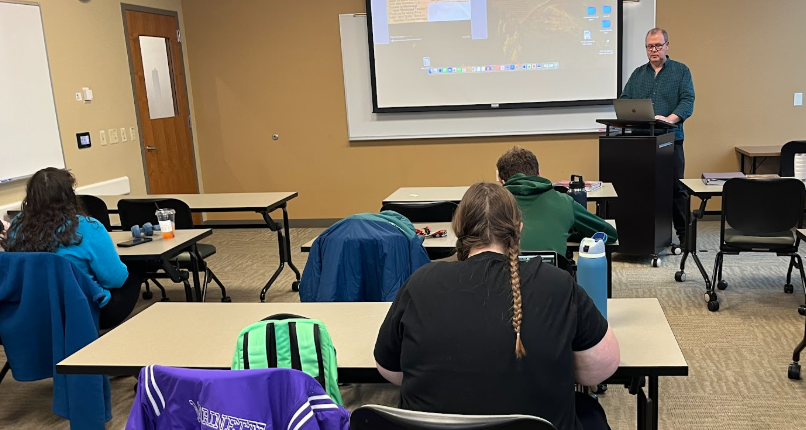
In the class, there are six Honors students in the class. Every class, each of us leaves with a different piece of knowledge (or way of thinking?- something like that).. That’s the magic of theater. Dr. Rupsch says the main goal of the course is to provide “an understanding of how art, politics, and culture all interact.”
I believe that I can speak for everyone when I say that we have gotten all of that and more. Classmate Brian Coulter (‘26) had this to say on the class: “It’s about the ties between history and what we’re learning with theater. It’s more than just basic facts; it’s our social history.”
Liz Reinier, a sophomore in the class, said that her favorite part is that “I’ve done theater for a long time, so learning about the history behind it is really interesting to me. I also kinda like the small class size.” I would say pretty much the exact same thing.
Another student, Alaina Kwiatkowski, points to her favorite part being “the professor. He is a very understanding and enthusiastic instructor who makes every class interesting. I always appreciate the effort he puts in to provide us with unique perspectives and the freedom to interpret the shows we read in class independently.” I couldn’t agree more. Dr. Rupsch, meanwhile, finds the most rewarding part of teaching it and all of his other classes to be “demystifying what theater is for people so people who have never been might go to see a show.”
The Honors class works by combining lecture materials, textbook readings, and engaging in actual, real-world plays and musicals that are relevant to the current unit. This usually means that we end up watching, reading, and greatly enjoying some of the most iconic, successful, and critically acclaimed plays and musicals of all time. Then we talk about them, find out what other ways the world has been shaped by those sorts of theatrical developments (and vice versa), rinse and repeat. It’s a regular pattern that still leaves room for plenty of surprises in store. It’s about more than just the history of theater; it’s a way of looking out the window and understanding the world that we’re seeing today. Dr. Rupsch stresses the idea that things that have historically happened and things that are currently happening in the world can all be correlated to some kind of artistic expression: past, present, or future.
Speaking of the future, it’s a testament to the great class Dr. Rupsch has built that we six Honors students are now heading into it with a broader sense of what theater really means. As the professor says, “It’s a communal experience. In today’s world, that’s a valuable thing.” I wish him luck in all of his future endeavors after this year and, on behalf of all of us, thank you for giving us such a gift this semester.
