By Brenna Cisler
It’s no secret that St. Norbert College Honors students love to learn as much as they can, expand their horizons, and get the most that they can out of their college experience. Usually this mindset applies to academics, extracurricular activities, and other awesome achievements, but this year, many members of the program continued that spirit in a new way: by hosting an international roommate. Three pairs of roommates and one group of four roommates spoke about their experiences thus far.
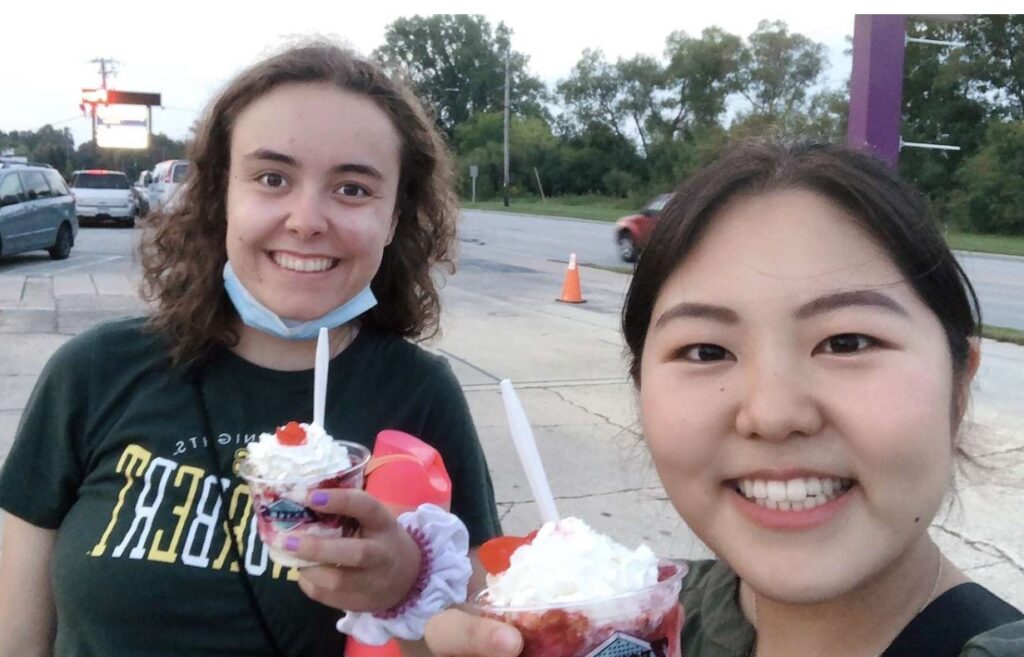
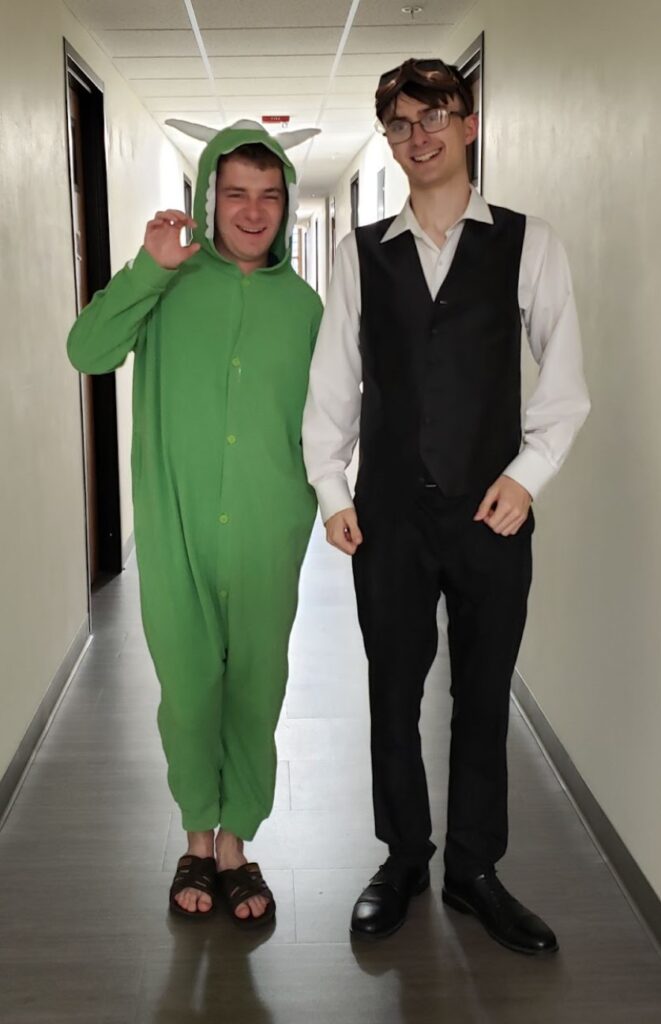
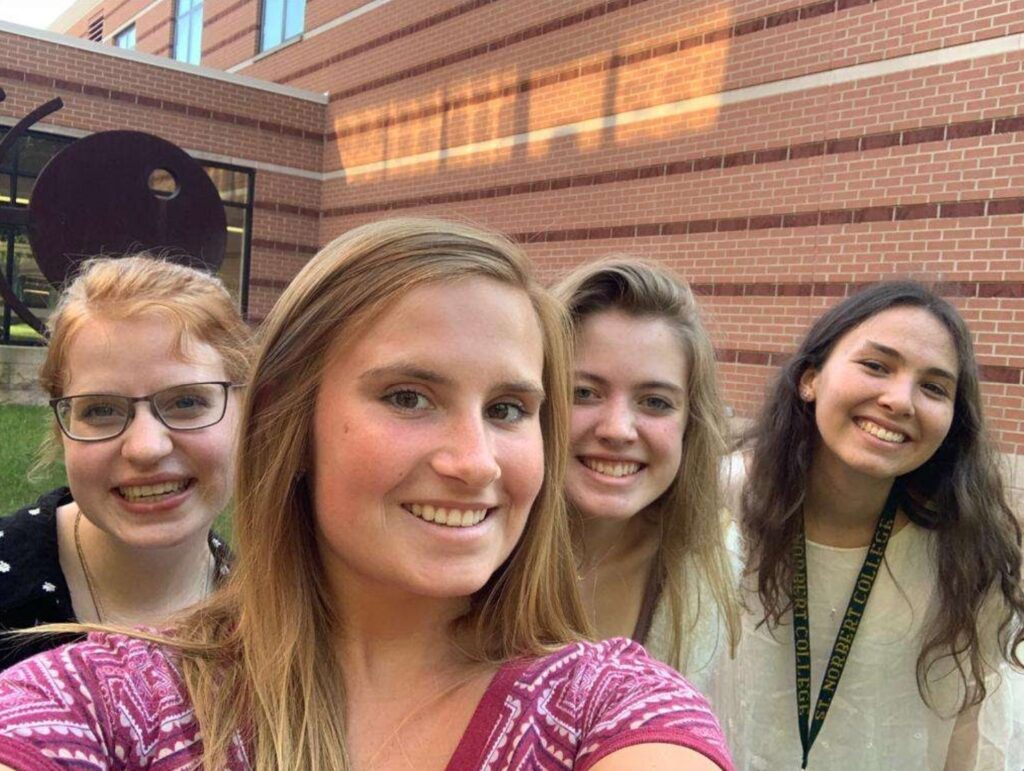
Eve McGuardian, from Paris, France, is rooming with Brenna Cisler ‘23. Yuna Imasaka, from Tsuru, Japan (1 hour from Tokyo), is staying with Bethany Kreklow ‘24. Alec Swatton, from Loughborough, Leicestershire, England (⅔ hours from London), is rooming with Anton Maslowski. Daniela Montalvo Tinajero, from Quito, Ecuador, is staying with Lexie Matte ‘24, Catherine Grey ‘24, and Erin Brown ‘24.
Since most of us who attend St. Norbert College or inhabit in the Midwest have lived in the United States for most of, if not all of, our lives, it’s interesting to hear what people who have lived elsewhere around the world find surprising about the United States. Imasaka remarked that, “The biggest thing is that everything is huge – food, portion sizes, chip bags, people – they’re so tall. Another thing; people here are also so friendly; we don’t smile at each other when we pass in Japan. Even though I don’t know the person here, sometimes they smile and say hi.” Montalvo Tinajero observed the same thing when noting that, “what surprised me the most is just how welcoming everyone is. I think it’s really cool because I just didn’t know what to expect. Coming here I was a little bit nervous about having three roommates. I had never had a roommate before and they were absolutely wonderful, and just in general, the whole community has been really great. And that is what surprised me the most: how at home I felt.” Swatton found the size of the United States to be the most surprising. He said, “I have not been to America before, but the thing that most surprised me is its size. It takes forever to get anywhere!” McGuardian also described the most surprising thing about the United States as “the food, the greasy food.”
Everyone has their own unique story as to why they decided to come to St. Norbert College and the global roommates shared their stories as well. Imasaka recalled that, “My university has two programs in the U.S. – one is in California at UC-Berkeley and the other is here.” Her roommate, Kreklow, then jumped in and exclaimed, “You didn’t choose California?!” They laugh and Yuna continues, “The reason I came here is because this school has a good education program. I’m interested in international education, so I thought it’d be a good opportunity to learn American Education. And it is a small campus so I thought I could be more close with teachers, and I wanted to be immersed in a Western country because, if I go to California, there are so many Japanese students – I think that that’s also good – but I can be here just one year so I felt like ‘why don’t I just be immersed in living in a Western country’s culture with, like no Japanese.’ The biggest thing, however, is that I love snow and the winter season. I know that there are huge cultural differences, but I wanted to share something in common with you guys. I feel like people can enjoy winter if it’s here – not in California. I thought that I could share the joyful winter and enjoy the winter season with people here and that would be the common thing for me. I wanted to have at least one common thing and, for me, it would be the winter season, so I chose here and I’m really glad that I chose here.” “That’s awesome,” Kreklow commented, “Now I understand why you didn’t choose Berkeley, although I have to say, I would have chosen Berkeley,” she laughs.
Montalvo Tinajero similarly was drawn to the small campus size and academics of St. Norbert College. She recalls that, “I was looking at different options and I saw a picture of the docks and I was like, ‘that looks so cool!’ So then I clicked on the picture and it gave me all this information about St. Norbert. One thing that really drew me in was how it was a small student population because that was important to me – to be able to get to know people around me and establish a relationship with my professors. Also, the different programs that St. Norbert had, such as the Peace and Justice minor, which was really cool because that is something that I have been interested in and I didn’t know that there was such a thing as a minor in that.” Swatton too was drawn in by our beautiful campus and the snow. He remarks that, “when choosing a college, St. Norbert attracted me because the pictures I saw of it looked really pretty in the snow, and it seemed to be a tight-knit community (it is!)” Although she also enjoys the picturesque campus and the small class sizes, McGuardian didn’t choose St. Norbert based off of those qualities. She recalls that, “I didn’t have a choice. They offered me a one year spot and I took it.”
Most people might agree that traveling to a new country and knowing that you will be spending the next several months there away from home would be nerve-racking, but surprisingly, many of the international students were not fazed by this thought. Imasaka said, “Honestly I was not that nervous. My curiosity and my feeling that I want to challenge something is more than the nerves of staying. Of course, language is difficult, but I can communicate at least, so if I can have a good friendship with someone, the language will not be that much of a barrier for me to share my difficulty with someone and ask for help from someone. So that was just the one nervous thing.” Since Montalvo Tinajero lived in the United States in Virginia in high school, she was not too nervous about coming, as was McGuardian, who lived in New York for the first 15 years of her life before moving to Paris for high school. Swatton, who had never been to the United States, on the other hand, was honest when he said, “I would be lying if I said no! – I was a nervous wreck.”
Just like many Honors students, these international students are highly involved in activities and organizations on our campus. Imasaka disclosed, “Bethany and I are doing Intramural basketball. I did intramural volleyball. Currently, I am the Vice President of Japan club. We established SNC Overseas which is a club for international students and I’m Vice President in that club too. I joined Ski Club; I am doing ultimate frisbee; I do ballroom dance. I’m doing TRIPs – I’m doing affordable housing, so in Arkansas. I’m in Aspiring Educators. I volunteered at SNC Day with kids doing activities.” Montalvo Tinajero also came up with an impressive list when asked if she had clicked with any organizations, “Yes! So we actually just came back from Knightingales (the all-women acapella group on campus) and that’s been really fun. I’m also in philosophy club, then I did intramural badminton club with Lexie – it was short lived – but we did do that. I’m in Pause for Paws. Oh! And I have been going to the SNCO which is the SNC Overseas for the international students (and anyone who wants to join).” Swatton also listed his involvements and what has made the most to him about each one, “I am currently involved in a number of organizations on campus, including; Circle K, SNCO, Cru and the St. Norbert Times. Three have stood out for me; Circle K, for providing a rewarding experience; Cru, for inviting me on a trip to Lake Lundgren Bible Camp, and the St. Norbert Times for providing a place where I have fostered friendships.” McGuardian has also found a home in the organizations, “the social group CC Hams and the French Club on the executive board.”
Making the decision to come abroad is one thing, getting over the nerves to come is another, but adjusting to a completely new culture is something entirely different. When asked how the adjustment to a new country has been, Imasaka reported that, “I noticed that being confident is a very important thing in America. Being myself and being confident. Especially at St. Norbert, people are so kind so it was very, not easy, but I think, compared with other places, it was more easy to be confident. Even the small things, like, for me, people listen to me even though I take so many times to speak, but people still wait for me to speak so that really helped me in the first month so that I could speak up and practice to be confident. That’s what I really appreciate from people here. The small size of classes and the small school also helped me adjust.” Regarding the adjustment, Montalvo Tinajero echoed, “Honestly, I know it’s kind of surprising, but it’s been very smooth. I don’t think that I’ve felt homesick, which is pretty wild to think about. I felt immediately welcomed from the moment I arrived into the room. We haven’t had any tensions or anything like that – it just – it feels like I’m where I’m supposed to be. So the transition has been really good.” Swatton also felt the warmth of friendship immediately on campus which helped with the transition, “The people I have around me, including my roommate and his (and now my) friends have made me feel so welcome and helped by taking me under their wing – so to speak. The small campus, and the lecturers, have made me not worry too much about my academic work, as I know I can go to them if I am struggling.” McGuardian, since she was initially from the United States, remarked that, “It’s not so much a new country since I am from New York, it’s the Midwest. I’ve only grown up in big cities so people around me have always been very international. I’ve always had people with the same education, the same parents, I’ve always been in the same social circle. It’s very different because no one here grew up the same way I did: I know more than two languages, I’ve lived in several different countries.”
Anytime that one goes abroad, it is safe to say that they will learn something from their experience. For Imasaka, when asked what this international experience has taught her so far and general takeaways that she has had, she noted that, “The culture is different, but I kind of feel like we are all humans and people living on the earth, so coming here, America is a big country and people speak English and the culture is different. I thought it’d be totally different people living here, but actually, even though the language is different, I can have good friendships here and I really enjoy talking with people, and even though the language in the countries is different, we are all human. Since I’m learning international education, we can cooperate with each other even though the countries are different. For example, I am Japanese, but I’m also a citizen of the earth. The differences are not that big. The international experience made me realize that there are so many differences, but we are also human, so the borders of countries are not that important to become friends and to work with them, and especially in the future, working together to solve problems on the earth, around the world.” Similarly, Montalvo Tinajero observed that, “I think that we’re a lot more similar than what it seems at first. You know, we come from different backgrounds, but then we have the same experiences.” Swatton noted that, “So far, the international experience has taught me that change is a good thing, as I was at first reluctant to sign up for a year abroad – a lot could have gone differently. But now, I feel a lot more confident, and happy that change does not necessarily mean something bad. In addition, interacting with people from a different culture has been a rewarding experience, and has taught me to remain mindful and humble of everyone’s feelings and considerations.” For McGuardian, living in the Midwest has taught her that, “I belong in big cities, you know what I mean? I’m international – I need to be with an international crowd – that’s where I feel at home, you know? It isn’t a country, it’s where I’m with people. Even though I love it here, I don’t feel really in my place.”
Naturally, when one travels to a new country, they are going to notice differences in the two cultures. Imasaka noted that, “People have their own identity here, even when in a group they have their own. Like, for example: food. Here we have so many options, whereas in Japan, we get one combo and that’s it. And the fashion, some wear very sporty, and I love it, and some are very dressed up all the time, and I also like it. I can wear what I want to wear and be who I want to be, and people accept me whoever I am and I like it. When I was in Japan, it was like we tried to have harmonious group communications and tended to be similar. Here, everyone has their own identity and they show that and that’s awesome. One more thing I like at St. Norbert is that there are so many sports teams and I’m so surprised that people can study and do sports and other activities at the same time. So many students are involved in another community, a sport, or activities. They also do volunteering a lot.” Daniela also noticed differences in culture between here and Ecuador. When asked what the biggest differences were, she exclaimed, “The food! That’s a really big one. You know, because dinner is supposed to be at 8pm, and here it’s 5 or 5:30 or even 6. That was one of the biggest things I think that really surprised me because I was like, ‘Oh my gosh! You don’t eat for the rest of the night? You have to wait until breakfast!’ Also, I think here, people are very welcoming. I don’t know if it’s just a St. Norbert thing, but in Quito, or at my university, people wouldn’t be – I don’t want to throw them under the bus – but people don’t take a really deep interest in other people’s activities as much. And I guess here, people do a lot of things together. We do Knightingales, all of that stuff, but that’s not very common there, it’s kind of like everyone does their own thing, and if you happen to end up doing something with someone else it’s like, ‘okay! cool!’ but it’s not planned.” Like all of the international students at some point, Swatton noted that the weather was something that stood out to him about coming here. “Definitely the weather – it went from being so humid to so cold in a heartbeat – I swear the weather in America (or just Wisconsin) tries to kill its inhabitants!” he joked. Showing her Parisian side, when McGuardian was asked what the biggest cultural difference that she observed between Midwest America and Paris, she responded, “Fashion. We never, like, if you go to a university in France, it’s like a fashion show. People do not wear sweatpants – that’s for one.”
Even though the international students all come from different corners of the world than their American roommates, at the end of the day, we are all just college students making our own ways through life. When asked what Imasaka and Kreklow enjoy doing together, Kreklow replied, “We had a movie night last week, I showed her Hamilton,” and Imasaka noted, “she shares everything with me, the microwave, the TV, she brought me a caramel apple.” Montalvo Tinajero responded, “Painting our nails. Eating together – that’s kind of our ritual. We are all very busy, but we try to have at least one meal together a day. Going to the gym! I don’t always join them,” she and her roommates laugh, “but when I do, it’s always fun.” Keeping with the theme of doing normal college activities with each other, Swatton replied, “We watch movies together from time to time, but we also volunteer at Circle K together!” His roommate, Maslowski, added, “Our friends have a townhouse and we just like hanging out there. We watch movies together. We go for breakfast together most mornings when Alec doesn’t want to sleep in.” Cisler, McGuardian’s roommate, noted that, “We eat at the caf together from time to time, but most of our hang-out time is in the evening in our room. It’s nice to be able to just talk to each other about how each of our days went while we get ready for bed.”
When asked how their roommates have specifically made their experiences better, Montalvo Tinajero remarked, “They’ve been the best. We have a wall of words – this got started the night that I arrived and the first word I learned was lanyard. One of them asked me if I had a lanyard and I was like, ‘a what?’. So it’s little things like this. We also have a conversion chart” she points to a chart on the wall, “Celsius to Fahrenheit and it’s so nice. It’s the little things, you know, that are honestly really important to me. We don’t have to have this, but it makes it so much better. So they are just the best. I mean, they are the reason why I don’t feel homesick.” Grey, one of Montalvo Tinajero’s roommates, heartfully comments, “Awww. Don’t make me cry.” Swatton also had nothing but kind things to say about his roommate, Maskowski, and the positive impact he has made on his experience here, “Anton has been amazing, he has made me feel really welcome, he is friendly and we often go and have breakfast together at the caf. His insights into American culture and the way of life here has been pretty eye opening.” Additionally, when McGuardian reflected on Cisler’s impact on her experience, she said, “I remember the first day I came here, Brenna introduced me to her friends, she went to the caf with me, she gave me a little tour of my classes, that was really nice. Sometimes when I can’t get dinner, she brings me a bagel from the caf.”
On the flip side, the idea of being an American roommate applying to host a global roommate can be scary. Questions such as “will we get along?” “will she like me” and “will we be friends” are all natural to have when being paired with a random person to share a room with for the next year of your life, but they seem even more daunting when that person is from another country. When asked why she decided to host a global roommate, Kreklow notes, “COVID just made me really want to get out of my shell. I went to college an hour away from home so I haven’t experienced that much and I really just want to travel and meet new people and I couldn’t really do that with covid. So I thought ‘why not just meet new people from my room?’” Maslowski saw it as an opportunity to make a connection. He replied, “Truth be told, I hadn’t had the best experience with roommates in the past. I thought that, by having a roommate who would genuinely be excited to be on campus, even if my roommate and it weren’t friends, there would basically be a kind of built-in connection through the program. And also, just to kind of help Alec really find an entrance into St. Norbert College, and basically make sure I got a roommate who would talk to me,” he laughed.
Although the student traveling abroad certainly hopes to get a lot out of their experience, the students hosting also hope to learn and grow from the experience as well. On what she hoped to get out of this unique opportunity, Cisler recalled, “I hope to learn about French culture and improve my French speaking skills. I am currently taking French and took it last semester and would love to get a more immersive learning experience by hosting a global roommate. I mentioned that I am taking French in my application and I’m sure that that helped me be paired with Eve.” Maslowski reflected on what he hopes to get out of the experience with, “I hope to broaden my understanding of the world, obviously, and – I have been abroad before, to Scotland actually – and it’s almost a similar experience. It’s both more intense and less intense at the same time in the sense that you see everything in American culture a lot more objectively in the sense that you place how you do things against how another culture does things. The differences between them are obvious and your actual American sensibility from doing things or seeing the world becomes a lot more clear when you have someone who has never been in the United States before and is coming from a whole different background and has absolutely no prior experience with Wisconsin or with being in America. It’s an interesting process of feeling this responsibility to both represent the culture, but also be a little bit more objective about your own experiences because you recognize what is not universal, and also what is. Especially in the beginning, it is easy to recognize the ways in which your culture does things differently.”
When living with someone from another culture and country day in and day out, one is bound to learn something about that culture. Matte, one of Montalvo Tinajero’s roommates, when asked what she has learned, reflected that, “I think that we learned a lot of new words. Also, we learned that you’re supposed to have soup before every meal – and it’s not a creamy soup – it’s a vegetable kind of soup. So Daniela was feeling a little bit out of home when she came here and there was no soup. She also told us one time that there are a bunch of different little towns for something in Ecuador. There’s a strawberry town – you just go to the town purely for that thing and everything is based on that.” Montalvo Tinajero then chimed in, explaining, “It’s usually just one street because they are little towns and they sell one thing. Every store – one thing. So like, the jean town, every single store sells the same thing. It’s very different from American markets and how it works because there is no competition and everyone is selling the same thing at the same price. It’s not everywhere, just in one providence. The furniture town, the leather town, the bean town.” Cisler’s biggest takeaway from French culture that she has learned from McGuardian is, “I learned that French people put a lot more effort and a lot more value into how they dress and how they look than in the Midwest. Eve said that everywhere you go in France is like a fashion show because everyone dresses very nicely. I remember the first day that she was here – she had just been to Walmart for the first time – and she came back saying that she couldn’t believe that people go out shopping in their pajamas,” she laughed.
Since we are all a few months into the semester of living with an international student, and since there will be many more after us who would like to apply next spring, the question of what you would say to someone who is considering hosting a global roommate next year seems helpful. When asked, Kreklow remarked, “Definitely do it. Every day you learn stuff just by living with them. I feel like I’ve become a better person too because I’ve learned how exciting some things in my life are that I’ve just kind of forgotten the excitement of, like how cool some things in Wisconsin culture are, while getting to see things from other cultures.” Brown also commented, “ Do it. You are always going to wonder what if you didn’t do it, and it’s still a good experience, because you meet someone new and make a friend out of it, you get to meet other people from other countries, so you get a whole bunch of other cultures kind of all in one that you wouldn’t get otherwise. You can say, ‘oh I’ll take a Middleeastern history class or an Asian history class,’ but that’s not the same as experiencing it. Because it’s history – you learn it from an older perspective – but with Daniela, she can just tell us how it is, and her experience with her country.” Maslowski also encouraged hosting a global roommate based off of his positive experience, “I don’t want to discount that, in a lot of respects, I probably got super lucky. Just looking at other roommate pairs and other roommate groups I think that there are a lot of things about my experience that are universal across the board in the sense that you get someone who is excited to be at St. Norbert, and as long as you’re willing to answer more questions than you thought any person could actually ask,” he and Swatton both laugh, “I mean, it was expected, but it’s always going to always be more than you expect because there’s always going to be aspects of your culture that you never questioned before that you’re like, ‘Oh yeah! That does require an explanation!’ Especially things specific to the Midwest and that would definitely not seep into American pop culture at large.” Along the same lines, Cisler agrees, “Definitely do it! It is so interesting and so cool to host someone from a different country. Also, not only do you get to know your roommate, you get welcomed into a whole community of international students who you get to learn from, which is not something that I was expecting in the least, but is something that I am really happy about.”
We can all do things to enrich our college experiences. We can play sports, join social groups, and attend club meetings, but since we can also host a global roommate, it was interesting to hear how the roommates thought that hosting a global roommate enriched their college experiences. Kreklow believes, “I think it gave me a better understanding of the world, and it also gave me a whole new group of friends because, it feels like now that I have a global roommate, Yuna has introduced me to so many other people, like Daniela, and so many of the other global students and I just feel like that connection is really cool.” Grey also spoke about getting welcomed into the community of global roommates and how that enriched her experience, “I’ve really enjoyed having a foreign roommate because we get to do all the things that the foreign exchange students get to do. I feel like we’ve gotten to meet a lot of people through that, because it’s kind of like, I don’t know, kind of a club – either being a foreign roommate or having one, and it’s kind of cool to get to see all the different cultures and stuff. We had dinner with Anton and Alec one night and it was just really funny because we were all sitting there just pronouncing words for each other and talking about cultural differences. So for me, it’s just been really cool to actually be able to talk to people and not have to read online about everything. I just think it’s really cool.” Reflecting on how he believes this experience enriches one’s college experience, Maslowski describes, “I think that it gives you that objectivity or outside perspective. I think it’s perfectly fine to spend your entire four years here only living with people who had similar experiences to you and come from similar cultures as you, but I think that the purpose of college is to expand your mind, explore other perspectives, and place your own life in greater context with those around you. I think there’s no better way to do that than to have an international roommate. You’re not only putting your own perspective of how people in your own town or city did things or even your own state. You’re trying to then see ‘how does your country do things?’ I’m reading a science fiction book right now and, basically the only way you could get more objective is if you were rooming with an alien. Then you’d be seeing how your species does things,” he laughed. Swatton then chimed in with, “On my Visa, it does say that I am a documented alien.”
Even though we have only lived with our roommates for just over two months, we have already learned so much. Reflecting on what she has learned thus far, Kreklow remarked, “It has taught me that there is so much more than more to this world than the region that I am from, so much more to this world than the central Wisconsin area that I have always lived in. And even though, like Yuna was talking about, there are language barriers and stuff, we are all human and, at the end of day, we’re both just two college students living life.” For Cisler, the experience has sparked a longing to travel, “It has made me want to go abroad more and explore the world. Being around all of these international students has made the world seem smaller and made traveling not seem like such a big deal. I am actually seriously considering teaching English abroad now for perhaps a year or so after graduating so that I can explore this world and continue to learn about other cultures and how the one that I grew up in compares, both to learn from it, and also to appreciate it.”
Although we don’t like to think about it just yet, one day, at the end of the semester for Montalvo Tinajero and the end of the year for Imasaka, Swatton, and McGuardian, we will have to part with our global roommates. With most fellow students, especially those from the same state, there is always the possibility of seeing each other over breaks and after graduation. With a global roommate, however, that possibility becomes harder when you consider flight expenses, travel time, and pure distance. When asked if she will visit Imasaka after she goes back home to Japan, Kreklow exclaimed, “I want to! I want to explore places out of the country. I’ve lived in the Midwest and the Midwest only.” Grey, Matte, and Brown echoed, “Absolutely! I would love to! It’s absolutely beautiful!” Montalvo Tinajero then chimed in, laughing, “And you better!” Along the same lines, Cisler exclaimed, “I’d love to! I’d love to visit France one day, and if I can meet up with Eve again, that would be absolutely awesome!”
Applications for next year’s round of global roommate hosts will be available in the spring as well as program admittance emails, and assignments are generally released sometime in the summer.
Thank you so much to Bethany, Yuna, Anton, Alec, Erin, Catherine, Lexie, Daniela, and Eve for taking the time to share your exciting discoveries and awesome experiences with us! We are so happy that you have all had such positive and enriching experiences thus far and we wish you all the best of luck in all of your future endeavors, adventures, and international travels!