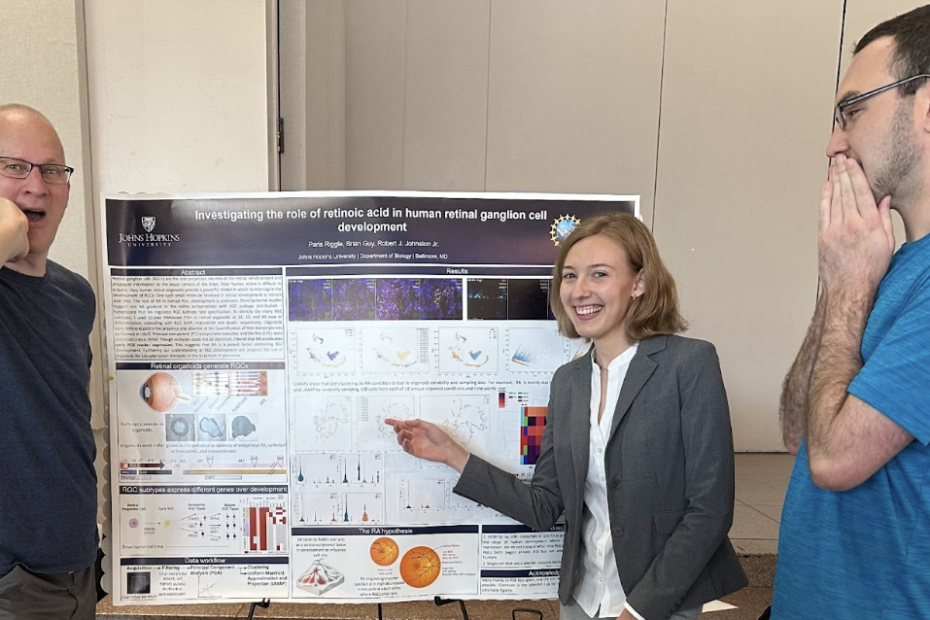
by: Paris Riggle
I was working on an experiment in the King Lab here at St. Norbert when I opened the email from Johns Hopkins University telling me I had been accepted to their summer NSF-funded REU fellowship. I was absolutely over the moon. Throughout the months that followed, I talked with the lab that I would be working in about potential projects. My first choice was the Johnston Lab, which studies cells’ seemingly random developmental fate choice in the Drosophila eye, as well as neuronal subtype choice in human retinal organoids. I chose to work in the organoid side of the lab. Retinal organoids are human embryonic stem-cell-derived mini-retinas grown in a dish. My project was investigating the role of retinoic acid in human retinal ganglion cell development. In other words, how does this small molecule affect the genes that guide a neuron to become a certain type. By better understanding how retinal ganglion cells develop, the goal is to grow all of the subtypes for transplantation therapies for glaucoma, a blindness-causing disease. My lab collaborates with the Johns Hopkins Medical Institute so I got to help with experiments at the medical campus as well. I had a rich research and networking experience at Hopkins where I visited several different labs, had an amazing PI and grad student mentor, presented at two conferences, and explored the Baltimore-D.C. area. I even got to visit with a recent SNC alumna who is pursuing her PhD at Hopkins. One of my favorite things was growing the organoids and seeing their remarkably fast development over time. I love the visual aspect of developmental and cell biology and getting to see gene expression fluorescently labeled. A fun challenge was learning Python programming language and writing code to analyze my massive dataset. There is so much Python can do and I will definitely make use of it in the future. I really got a sense of the graduate school experience and the sense of community within the department. The people in the lab and my 13 REU cohort members were extremely helpful and supportive of one another. I journeyed to Hartford, CT to present at the Leadership Alliance National Symposium, which is a consortium of Ivy and non-Ivy institution summer programs, led by Brown University, to promote inclusion and diversity in STEM and humanities. I saw work from summer researchers at other institutions spanning from astrophysics, to machine learning, to microbiology. On the weekends when I was not tending to my organoids, I was drawn to the many art galleries, coffee shops, and eclectic restaurants in Baltimore. It was special seeing the city come together for Fourth of July fireworks and Baltimore Symphony Orchestra concert by the harbor. Washington, D.C. was just a 45-minute train ride away so that opened up even more possibilities to see the sights. The Hopkins Homewood campus itself was just a beautiful place to work so I did not even have to go far to sit outside, relax, and contemplate experiment results under the magnolia trees. This experience has solidified my dream of attending grad school and pursuing scientific questions, particularly those surrounding neuroscience. I am grateful for the strong foundation that St. Norbert and my professors have offered me and am excited for what the future holds.
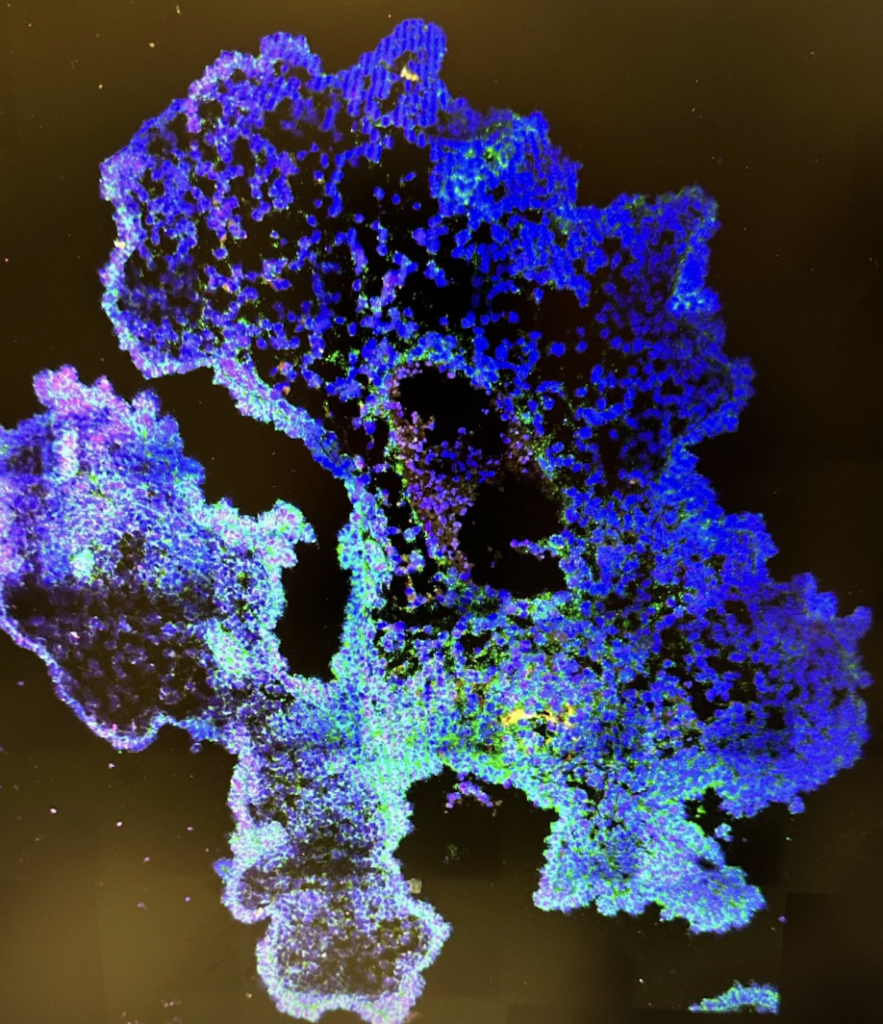
A section of a 50-day-old retinal organoid grown with RA. Blue is cell nuclei, and magenta cyan and green are 3 different genes expressed during development. The two lobes to the left are likely optic vesicles, where retinal tissue develops.
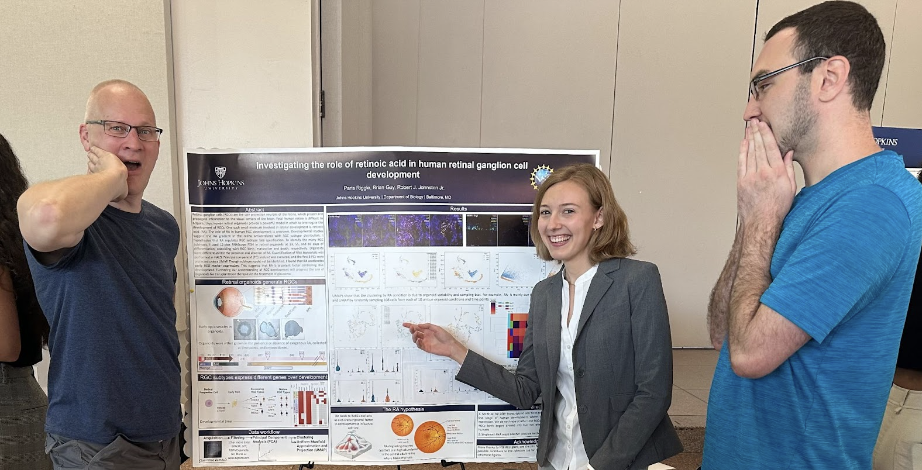
The poster presentation at the Hopkins Summer Research Symposium on campus. At the left is Paris’s PI, Dr. Johnston, and at the right is her grad student mentor, Brian.
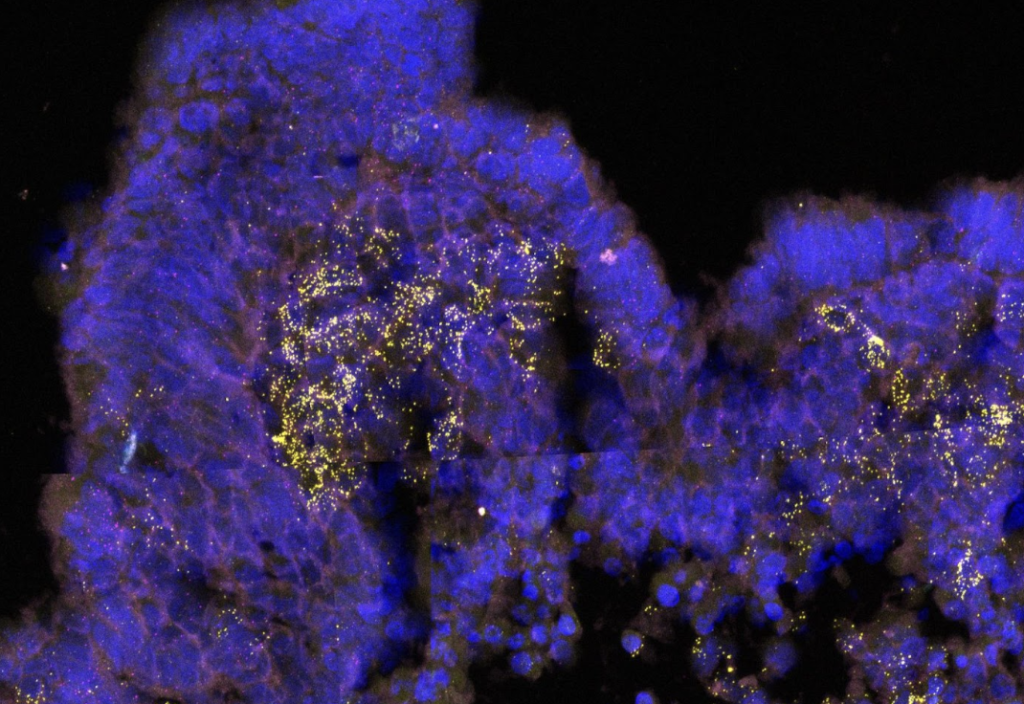
30-day-old retinal organoid section (zoomed in) grown without RA.
