by: Catherine Grey
In science, and indeed, in most research, it’s good practice to do something more than once. Your biology professor wants to see multiple trials of an experimental method, your English professor needs several sources to back up your claim about Jay Gatsby’s sexuality, and your dad requires at least seven articles from Fox News that say climate change is real. You need multiple test runs, multiple samples, multiple sources.
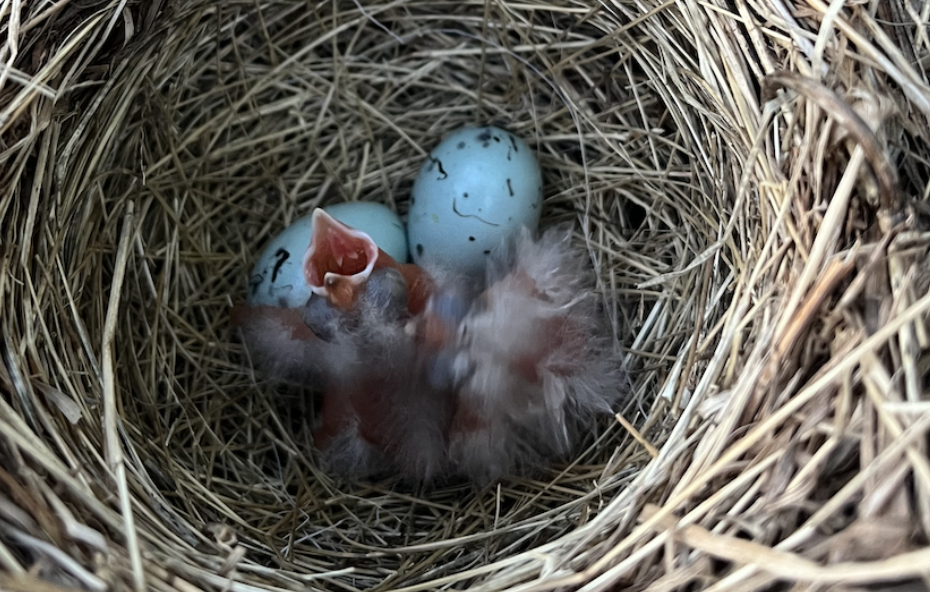
One would think that finding fifty-two nests over the course of about seven weeks would provide enough information to make and support a logical claim. And one would be absolutely right, except for the fact that of the data collected, none of them actually meant anything because at the end of the day, they were all the same:
“Nest BB13: Depredated.”
“Nest BB25: Depredated.”
“Nest BB8: Depredated.”
(Depredation, of course, means that the nest was found empty after previously holding eggs or nestlings. Because we didn’t see it happen, the egg or nestling could have been eaten by a predator or kicked out by a rival bird, so we can’t definitively say that it was “predated” – killed by a predator. Depredation, of course, is non-beneficial to someone trying to do an experiment with ten-day-old nestlings.)
So, actually, I suppose the data were perfectly conclusive: the Abbey Pond is simply a poor place to conduct an experiment on stress levels in red-winged blackbird nestlings. This proven fact (Sample Size: one summer) is made more odd by the fact that the Abbey Pond was thought to be a good site to field this experiment due to the sightings of multiple fledglings in the previous year (a fledgling differs from a nestling in that it has “fledged,” or left the nest. A nestling is still in the nest). Although it was a joke in the beginning of the summer between me, my research partner, and my PI (the “principal investigator,” or the professor in charge of me for the summer), due to the cleanliness of the nests and the 100% depredation across all nests, we began to suspect that perhaps, humans may have been the cause of the depredation events. “That darn ABC – Anti-Blackbird Coalition,” I would say, and then… maybe it was humans, pervasively removing birds known for being extremely territorial during breeding seasons. Or maybe it was raccoons who suddenly could climb reeds without leaving a trace of their work, or snakes that could suddenly slither several feet out to the eggs, or raptors who suddenly decided to eat the entirety of the birds (they commonly only eat brains after a little while), or maybe, simply a stork or heron who never really knew hunger that season due to a large population of hors d’oeuvres.
But I guess we’ll never know!
In the meantime, my summer was spent doing exactly what I wanted to do: fieldwork. I got the chance to work with my research partner on another project our lab was doing; this project used nest boxes (think: bird houses) that we placed in a field next to the Abbey Pond in very straight and precise rows (this is a joke). These boxes got filled by several different species of birds, including the dastardly, invasive house sparrows; the beautiful, native tree swallows; a single eastern bluebird couple; several poor wrens who never did finish their nests; and two or three sets of black-capped chickadees, whose babies were ever so cute, with their little feathered caps showing up at a little over a week old.
We poked and prodded the house sparrow and tree swallow nestlings, taking a little bit of their blood when they were five and ten days old (or seven and twelve days old – tree swallows take a little longer to get bigger). This blood we separated into two layers, and each one went to a different part of the project. The plasma, which was white and watery and sat on top when separated, was placed into vials that were eventually turned into a home for some bacteria. The white blood cells in the plasma were either able to fight off the bacteria, or let the bacteria flourish. The red blood cells, which were… red… and in a very thick bottom layer, we blew into vials (yes, blew. With our own breath) that will soon be used to look at the length of telomeres in the DNA of the red blood cells. This is a cool thing that we can do with birds’ red blood cells, but not humans’, because birds actually have nuclei in their red blood cells, which of course contain DNA – DNA are long strands of genetic code – capped with sequences called telomeres; the length of telomeres gives us information about how long the organism will live.
Why do we care about bacteria and telomeres? Well, in between the days in which we took blood from the birds, each nest was randomly placed into one of two groups – one group that received a night light, and one group that didn’t. The group that received a night light was the experimental group, testing how artificial light at night – or, the light we see from streetlights and houses – impacts their length of life (the telomere experiment) and their ability to fight off disease (the bacteria experiment) . The other group, of course, was a “control” group – no lights were shined on them, so that we could compare the experimental group to what was supposed to happen with no interference at all.
So, even though my main project was completely defunct by week eight of the summer, I still got a lot of practice handling birds, watching nest building, taking blood samples, and doing science. I also got to develop another experiment with my PI, which was very similar except also very different. Instead of using babies, I was using adults; instead of red-winged blackbirds, I was using zebra finches; and instead of being outside, I was in a lab setting. However, I was still looking at stress levels, taking blood, and having a lot of fun.
I had a great summer, despite the setbacks. That’s science though, isn’t it? We try and we fail and we try again and we possibly get impeded by people who hate red-winged blackbirds and so we try once more. But I’ve never had a summer like this one, which I am ever so grateful for (shoutout to Mark Stinski, who attended SNC from ‘59-’63 and is the donor for the Stinski Award, which allowed me to do this research); I hope the next one is somehow even better.
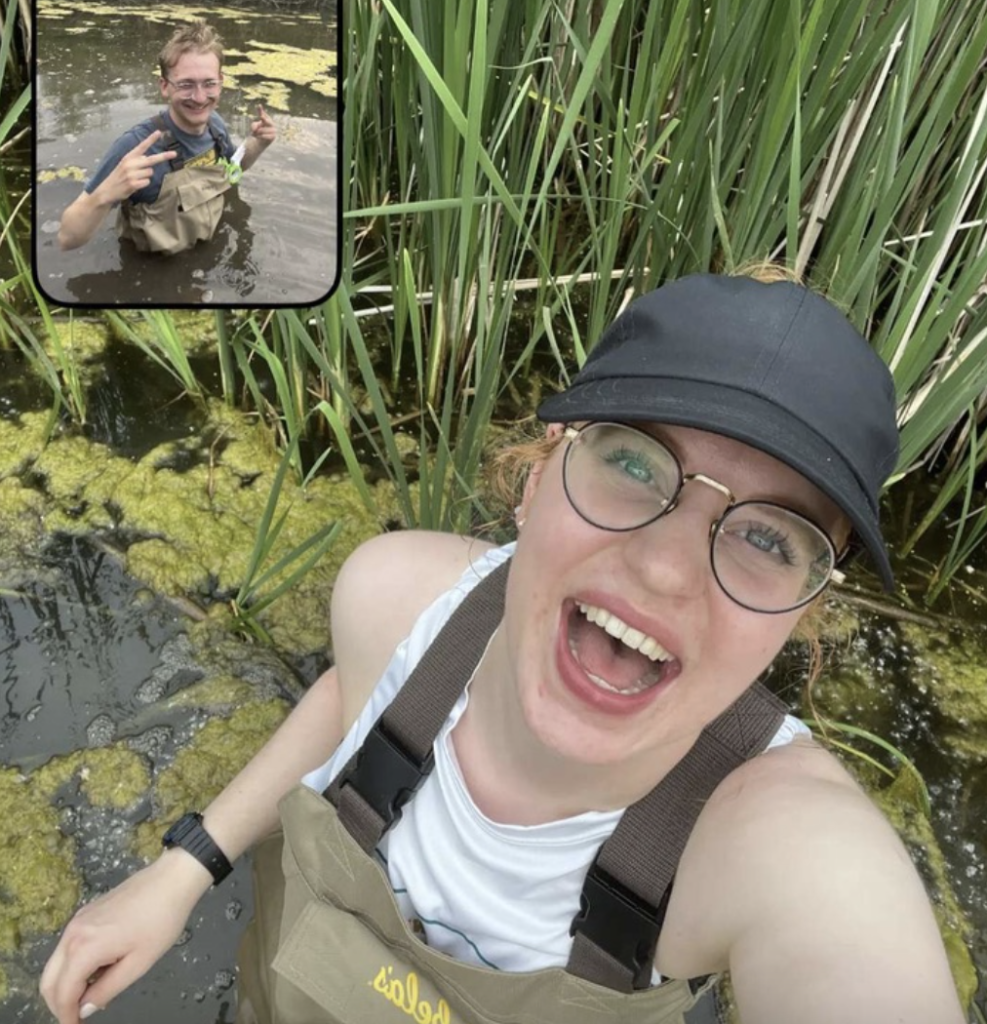
Catherine and her lab partner, Harrison, in the Abbey Pond.
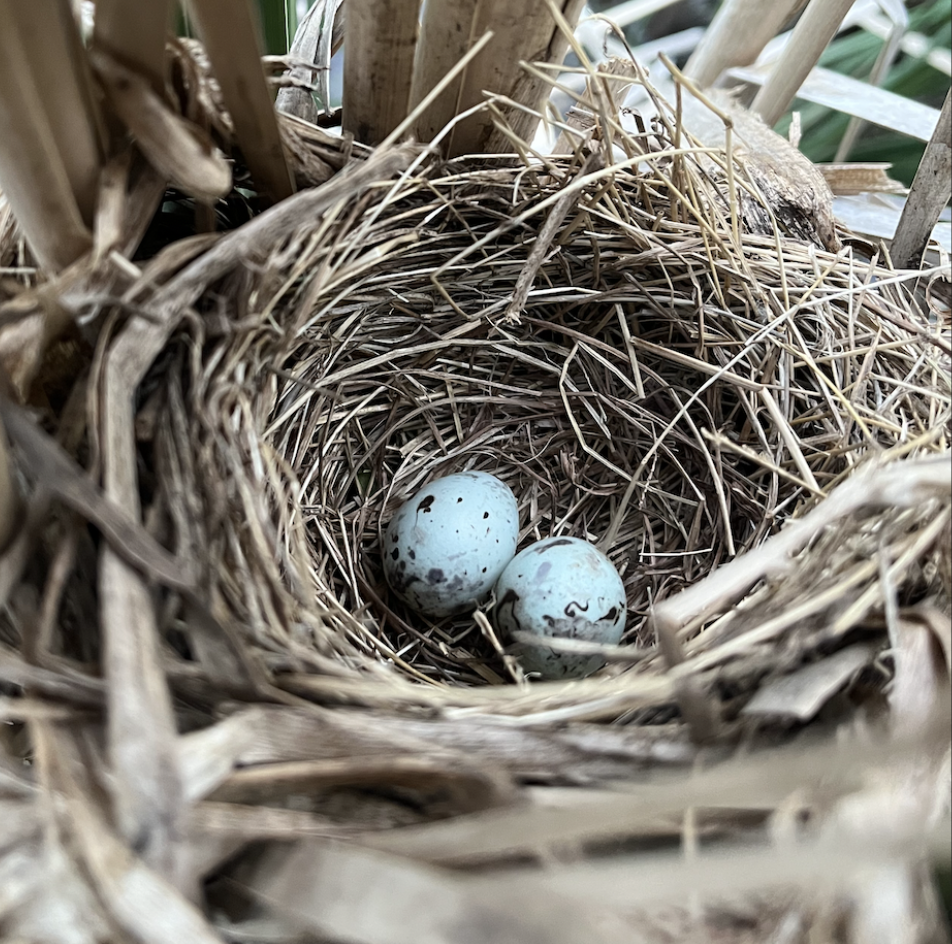
Blackbird eggs (photo taken by Catherine Grey).

Great work, a shame about the scheming of the ABC’s.